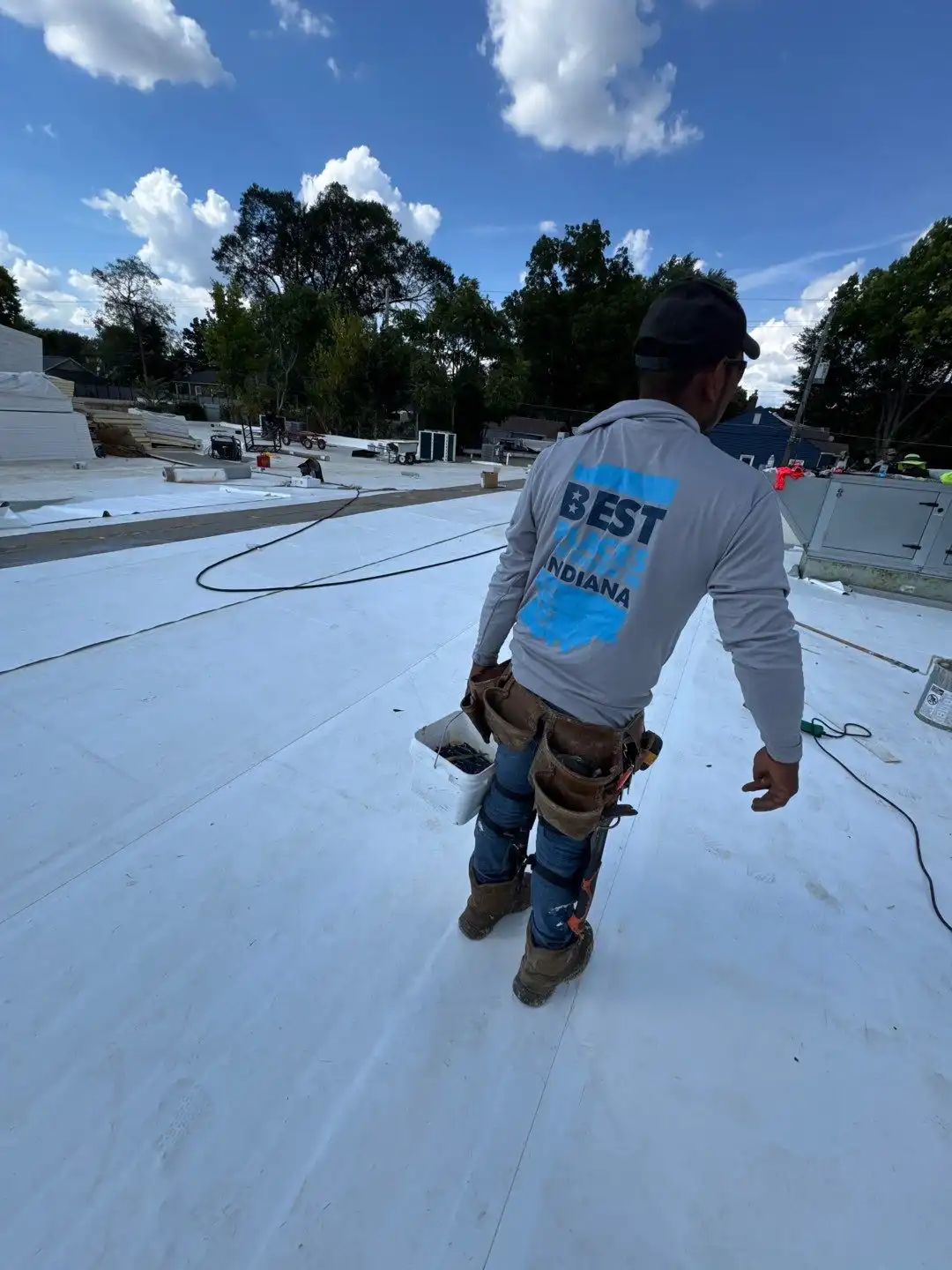
What TPO roofing is
TPO stands for thermoplastic polyolefin, and understanding what that means in practical terms helps a Nappanee owner grasp why the membrane behaves as it does. At its core, TPO is a single ply roofing membrane with some distinctive characteristics.
A single ply thermoplastic membrane
TPO is a single layer of thermoplastic membrane, meaning it is one sheet of material rather than the multiple layers of some other systems, and being thermoplastic means it can be heat welded at the seams. The membrane is typically reinforced with an internal layer for strength. For a roof, this single ply construction makes TPO relatively lightweight and efficient to install while the thermoplastic nature enables its signature welded seams. It is a modern membrane designed for commercial flat and low slope roofs.
The reflective white surface
One of TPO's defining features is its typically white, reflective surface, which bounces sunlight away rather than absorbing it. This reflectivity reduces the heat the roof transfers into the building, lowering cooling costs in warm weather. The white surface is a major reason TPO is popular, since energy efficiency matters to many building owners. For a Elkhart County building, the reflective surface is a practical benefit that helps with summer cooling, distinguishing TPO from darker membranes like EPDM.
Welded seams
Because TPO is thermoplastic, its seams are joined by hot air welding, which fuses adjacent sheets into a continuous, monolithic bond rather than relying on adhesive. A properly welded seam is as strong as the membrane itself, which makes seams, often the weak point of a roof, a strength of TPO when installed well. For a Nappanee roof, the welded seams are central to TPO's watertight performance, and the quality of the welding is key to how the roof holds up.
A modern, efficient membrane
Put together, TPO is a single ply, reflective, weldable membrane that combines energy efficiency, strong seams, and reasonable cost, which explains its popularity. It was developed to offer a balance of performance and value for commercial roofs, and that balance is why it became the most installed membrane. For a owner, understanding these basic characteristics is the foundation for evaluating whether TPO fits their building.
Learn whether TPO fits your building
The broader point about understanding TPO is that knowing what a membrane is and how it works lets an owner make a roofing decision rather than simply accept the default. A Nappanee owner who understands TPO's reflective surface, welded seams, lifespan, and cost can judge whether it fits the building, ask the right questions of a contractor, and recognize a quality installation from a rushed one. That understanding turns the most common membrane from a label into a choice the owner can evaluate on its merits.
Finally, whether TPO is the right choice comes down to the building, since the most popular membrane is not automatically the best for every roof. A owner who weighs TPO's strengths against the building's actual exposure and needs, and compares it honestly to the alternatives, makes a better decision than one who picks TPO simply because it is common. The membrane that fits the building is the right one, and understanding TPO is what lets an owner judge whether it is that membrane for their roof.
It also helps to remember that with TPO, more than with some systems, the installation determines the outcome, because the membrane's potential depends on properly welded seams and careful detailing. A Elkhart County owner who prioritizes a skilled, experienced installer gets the full value TPO can offer, while one who chooses purely on price may get a membrane that fails early through poor welds. Understanding that the installation matters as much as the membrane is among the most useful things an owner can take from learning about TPO.
The broader point about understanding TPO is that knowing what a membrane is and how it works lets an owner make a roofing decision rather than simply accept the default. A Nappanee owner who understands TPO's reflective surface, welded seams, lifespan, and cost can judge whether it fits the building, ask the right questions of a contractor, and recognize a quality installation from a rushed one. That understanding turns the most common membrane from a label into a choice the owner can evaluate on its merits.
Finally, whether TPO is the right choice comes down to the building, since the most popular membrane is not automatically the best for every roof. A owner who weighs TPO's strengths against the building's actual exposure and needs, and compares it honestly to the alternatives, makes a better decision than one who picks TPO simply because it is common. The membrane that fits the building is the right one, and understanding TPO is what lets an owner judge whether it is that membrane for their roof.
It also helps to remember that with TPO, more than with some systems, the installation determines the outcome, because the membrane's potential depends on properly welded seams and careful detailing. A Elkhart County owner who prioritizes a skilled, experienced installer gets the full value TPO can offer, while one who chooses purely on price may get a membrane that fails early through poor welds. Understanding that the installation matters as much as the membrane is among the most useful things an owner can take from learning about TPO.
The broader point about understanding TPO is that knowing what a membrane is and how it works lets an owner make a roofing decision rather than simply accept the default. A Nappanee owner who understands TPO's reflective surface, welded seams, lifespan, and cost can judge whether it fits the building, ask the right questions of a contractor, and recognize a quality installation from a rushed one. That understanding turns the most common membrane from a label into a choice the owner can evaluate on its merits.
Finally, whether TPO is the right choice comes down to the building, since the most popular membrane is not automatically the best for every roof. A owner who weighs TPO's strengths against the building's actual exposure and needs, and compares it honestly to the alternatives, makes a better decision than one who picks TPO simply because it is common. The membrane that fits the building is the right one, and understanding TPO is what lets an owner judge whether it is that membrane for their roof.
The broader point about understanding TPO is that knowing what a membrane is and how it works lets an owner make a roofing decision rather than simply accept the default. A Nappanee owner who understands TPO's reflective surface, welded seams, lifespan, and cost can judge whether it fits the building, ask the right questions of a contractor, and recognize a quality installation from a rushed one. That understanding turns the most common membrane from a label into a choice the owner can evaluate on its merits.
Nappanee Commercial Roofing helps Nappanee owners understand TPO and evaluate whether it suits their building's roof. Call (765) 676-3491 to learn whether TPO is the right membrane for your building. Understanding the membrane is the first step toward a smart roofing decision rather than a guess.